dsh-agent-teams
ExperimentalRuns locally ✓No paid APICoordinates a team of agents in DSH to split work and track progress.
dsh plugin --profile web add --save-exact @nanmicoder/dsh-agent-teams@0.1.20Ideal use for this tool
For development work that can be divided into dependent tasks and reviewed as a plan before agents start. Monitor outputs and model costs; team state is not coordinated across separate processes.
Details and illustrated features
dsh-agent-teams gives the current DeepSeek Harness session a captain that can divide a larger goal into dependent tasks, assign members, track their work, and consolidate the result. More agents can increase model usage; cost savings are not guaranteed.
🧭 How it works
The current agent becomes captain and proposes a roster, tasks, and dependencies. In the normal /agent-teams flow, the Web panel stages this plan without spawning members. Execution begins when you choose Approve & Run.
🌟 Key features
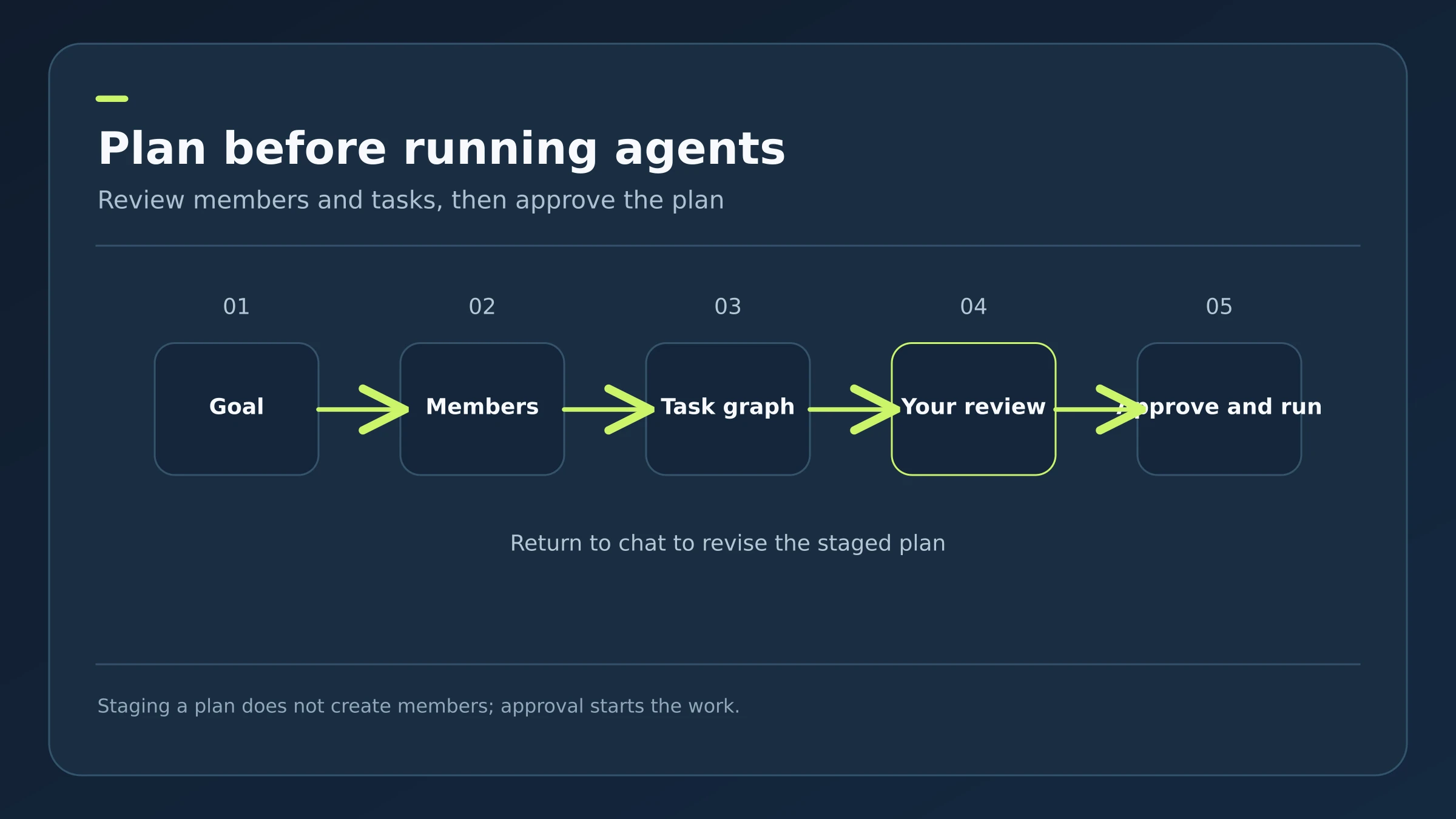
1. Plan before starting agents
Type /agent-teams followed by your goal. Inspect and edit the roster and task graph in the panel, return to chat to revise it, or discard the plan. Approval creates members and starts scheduling; viewing a plan does not start the team.
2. Dependency-aware scheduling
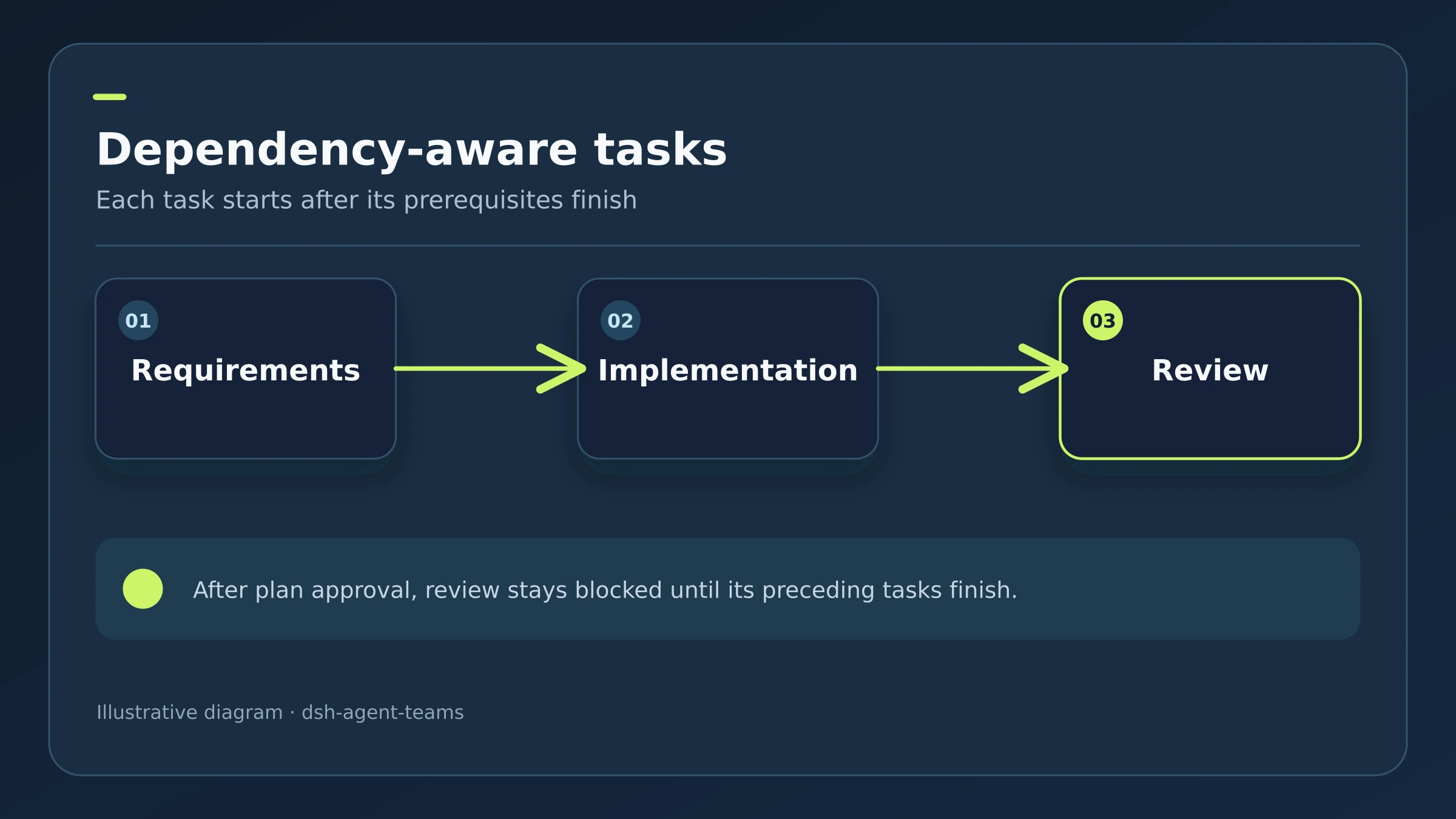
Tasks record owners and prerequisites. When work is ready and a member is idle, the scheduler assigns it. Reassignment revokes stale attempts before another member proceeds; cold recovery retries stranded open work. Review the output yourself: a model can finish without making the expected task-state update.
3. Activity view and direct messages
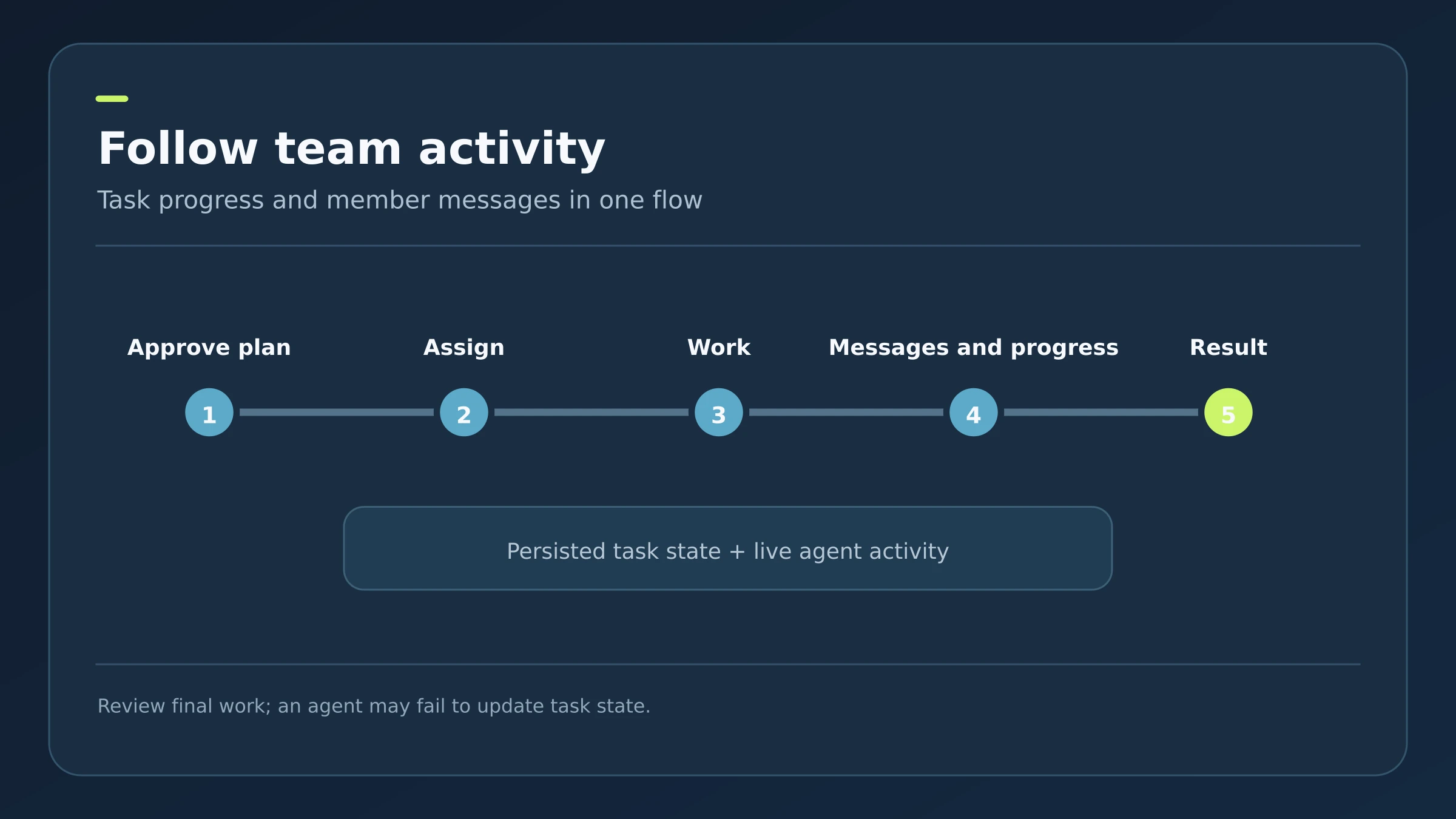
The Web panel shows progress, members, and the task dependency graph; archives retain team history. Members can send durable direct messages to one another or the captain and continue in later turns. According to the page, state lives in <workspace>/.agent-teams/.
4. Model routes and optional quality tasks
You can explicitly request different providers and models for members. A member using the captain's route inherits its effort; an alternative route uses the target model's default unless you specify effort. Optional quality tasks cover requirements, implementation, verification, and review. Scope control audits work at completion; it does not technically intercept writes.
🪜 Illustrative workflow
Try: /agent-teams review the Nasq project's changes for performance, security, and user experience; return one report. Inspect the roster and dependencies before approval, follow progress in the panel, and verify the final report. This is an illustrative example; we did not run the plugin.
⚖️ Compared with manual coordination
| Manually | With the plugin |
|---|---|
| Delegate and check work in chat | Recorded tasks, dependencies, and progress panel |
| Relay findings between members | Durable direct member messages |
| Reconstruct progress on return | Continuable members and persisted team state |
🚀 Installation and compatibility
At the time checked, dsh-market recommends DeepSeek Harness 0.1.5-rc.1 with AgentTeams 0.1.20; both are prereleases. Check your host version first. The documented command for this pair is dsh plugin --profile web add --save-exact @nanmicoder/dsh-agent-teams@0.1.20. Stop and restart Harness, then refresh the browser. Desktop users must check the embedded Harness core; upgrading the global CLI does not upgrade it. Pin the documented pair for reproducible compatibility.
⚙️ Configuration and cost
Defaults need no extra setup. Documented options include maxMembers, memberMaxDepth, the state directory, and a member model default. memberProvider names the sub-agent runtime, not the LLM provider; member-specific provider and model use separate route fields. The page lists an MIT license. Model-call costs depend on your provider, and the page does not establish offline operation.
⚠️ Limits and security
One captain can lead one active team at a time. File-backed state is serialized within one DSH process, not coordinated between processes editing the same team. The plugin runs with DSH permissions and may access files, credentials, and network; review third-party code and permissions before installation, and review changes before merging or deploying. The documented interface follows English and Simplified Chinese; Arabic annotations here are illustrative rather than official UI localization.
📚 Source and verification
dsh-agent-teams on dsh-market — checked 2026-09-23. Claims are attributed to that page; we also checked the GitHub README on 2026-09-23; we did not run the plugin. GitHub showed about 1.8k stars and 155 forks at inspection; these counts change. The three images are original illustrative diagrams, not UI screenshots.